App Logo
Productivity Reduck MCP

Let Claude and ChatGPT watch YouTube videos through the full transcript (2026)

Prompt template

Get the transcript of this YouTube video video link, then summarize it, list the key points with their timestamps, or answer my question.
Overview

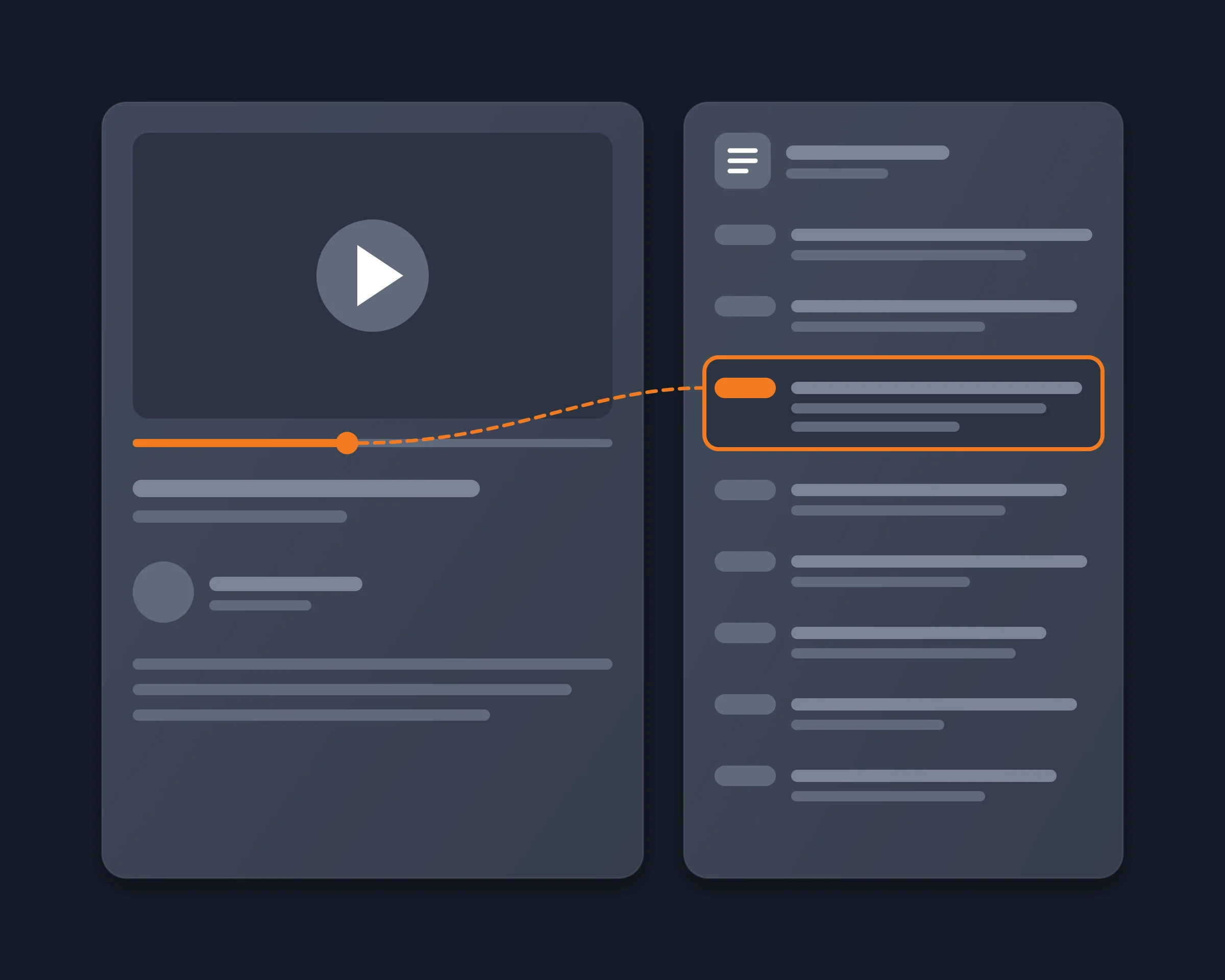
Reduck gives Claude and ChatGPT a YouTube video's transcript, with timestamps, from your own Chrome.

Claude and ChatGPT cannot watch a YouTube video from its link: they get the title and the description, not what is said. Founders, students, researchers and creators learn from YouTube: a conference talk, a tutorial, a podcast, a competitor's video. They want to paste a link into Claude or ChatGPT and ask for the key points, a summary or one precise answer, without watching an hour of video. With Reduck, your AI agent gets the full transcript of the video and works from what was really said.

Can Claude watch YouTube videos?

Not by itself. Claude's apps take documents and images, not a video, and a pasted YouTube link gives Claude the page around the video, not the words spoken in it. So Claude says it cannot open the video, or it guesses from the title. Give it the transcript, and Claude can summarize, quote and answer questions about every part of the video.

Can ChatGPT watch YouTube videos?

Not from a pasted link. ChatGPT can search the web and find the video's title and description, but the spoken words are not on the page it reads. With the transcript, ChatGPT works on the video like Claude does. Reduck connects to both, as an MCP server.

Why it's hard

  • A link gives the page, not the words. When you paste a YouTube link, Claude or ChatGPT can read the page around the video, such as its title and description. The captions load in YouTube's video player, so the spoken words never reach the model. Without them, it says it cannot open the video, or it guesses from the title.
  • YouTube has no transcript API for other people's videos. The YouTube Data API's captions endpoints need an authorized account and are meant for videos that account can edit.
  • Transcript tools that run on a server get blocked. The README of youtube-transcript-api says YouTube has started blocking most IPs that belong to cloud providers such as AWS, Google Cloud and Azure.
  • Copy and paste does not scale. YouTube shows a transcript under the video ("Show transcript"), and you can paste it into the chat. That is one video at a time, by hand, every time.

How Reduck does it

Your AI agent runs Reduck's YouTube scripts in your own Chrome, through the Reduck extension, from your own connection. You need no API key, no transcript service and no server.

  1. It gets the transcript. get_transcript takes the video's id and returns its caption track, uploaded by the creator or generated by YouTube, as segments, each with its start time and duration in milliseconds, and the language of the track. A video with no captions returns available:false.
  2. It gets the context. get_video returns the title, the channel, the length, the publish date and the description.
  3. It finds the videos. search_videos searches YouTube by keywords, or lists a channel's or a playlist's videos from its URL, so your agent can read several videos on one subject.

Then your agent does what you asked with the transcript: a summary, the key points with their timestamps, quotes, the answer to your question, or notes for your own work. You read a one-hour talk in two minutes, and you can check every point at its timestamp.

What it returned on a real video

On November 20, 2026, we ran get_transcript on Tim Urban's TED talk "Inside the mind of a master procrastinator" (video id arj7oStGLkU), in our own Chrome. It returned available: true and every caption line of the 13-minute talk, from 0:00 to 13:46, each with its start time and duration, including the audience reactions such as "(Laughter)". The track it returned was French: get_transcript reads the video's default caption track as YouTube serves it to your browser, and returns its language code. Claude or ChatGPT then translates it, or answers in your language.

What you can ask once your agent has the transcript

  • "Summarize this talk in 10 points, each with its timestamp."
  • "Where does the speaker talk about deadlines? Give me the exact quotes."
  • "List every tool, book and number mentioned in this video."
  • "Get the last 5 videos of this channel and tell me what they have in common."
  • "Turn this tutorial into a step-by-step checklist."

How to start

  1. Create a free account at reduck.ai.
  2. Install the Reduck extension in Chrome and pair it.
  3. Connect Reduck to your agent: docs.reduck.ai.
  4. Ask: "Get the transcript of this YouTube video {video link}, then {summarize it, list the key points with their timestamps, or answer my question}."

Ways to give Claude or ChatGPT a YouTube video, compared

As each tool's own page describes it, read on November 20, 2026. "Not documented" means we did not find it on their page.

Gets the spoken words Several videos in one request Runs from Setup Price
Reduck Yes, the caption track with timestamps Yes, from a search, a channel or a playlist Your own Chrome Chrome extension and MCP connection There is a free tier
Paste a YouTube link No, the title and description at best No The assistant None Your Claude or ChatGPT plan
Gemini app Google says it uses public YouTube information to understand a video's content Not documented Google Signed in, with Gemini's History setting on Your Google account
Copy "Show transcript" by hand Yes No You None Free
youtube-transcript-api or yt-dlp Yes Yes, with your own code Your computer, or a server that YouTube can block Python or the command line Free
Hosted transcript MCP connectors Yes Yes The vendor's servers Add a custom connector Credits, from the vendor

Where Reduck is weaker: it reads only the videos that have captions, and it does not transcribe the audio. It reads the words, not the images, and it runs only while your Chrome is open.

FAQ

Not by itself. A YouTube link gives Claude the page around the video, such as the title and the description, not what is said in it. With Reduck connected, Claude gets the video's full transcript with timestamps, and can then summarize it, quote it or answer your questions about it.
Not from a pasted link: ChatGPT can find the title and the description, not the spoken words. With Reduck connected to ChatGPT as an MCP server, it gets the full transcript of the video, like Claude does.
No. The transcript holds what is said, not what is shown. For a slide, a chart or a demo, add screenshots of those moments to the chat, and Claude reads them as images.
Then there is no transcript to get. Reduck's get_transcript script returns available:false for a video that plays but has no captions in any language, so your agent tells you instead of guessing. Reduck does not transcribe the audio itself.
In the video's default caption track, as YouTube serves it to your browser. It is not always the language of the speaker: on Tim Urban's English TED talk, our test on November 20, 2026 returned the French track. The script returns the language code of the track it read, and Claude or ChatGPT translates it.
Yes. The search_videos script lists a channel's or a playlist's videos from its URL, or searches YouTube by keywords. Your agent then gets the transcript of each video it picks, one run per video.
Many of them fetch the captions from a server. The README of youtube-transcript-api, a popular open-source library, says YouTube has started blocking most IPs that belong to cloud providers such as AWS, Google Cloud and Azure. Reduck reads the captions in your own Chrome, from your own connection. A run can still fail when YouTube does not serve the captions in time: your agent runs it again later.
Not for any video. The YouTube Data API's captions endpoints need an authorized account and are meant for videos that account can edit. So it gives you the captions of your own videos, not those of a talk or a tutorial someone else posted.

Similar use cases

Claude ChatGPT Brave

Brand visibility in Claude and ChatGPT

Your AI agent asks your buyers' questions in claude.ai and chatgpt.com, signed in as you, and reports whether each answer names or cites your brand, which searches the assistant typed, where your pages ranked in each, and who wins instead.

Market intelligence

Start building not clicking